The Seawall Question: What Actually Reprices An Apollo Beach Canal Deal
August 6, 2026
August 6, 2026
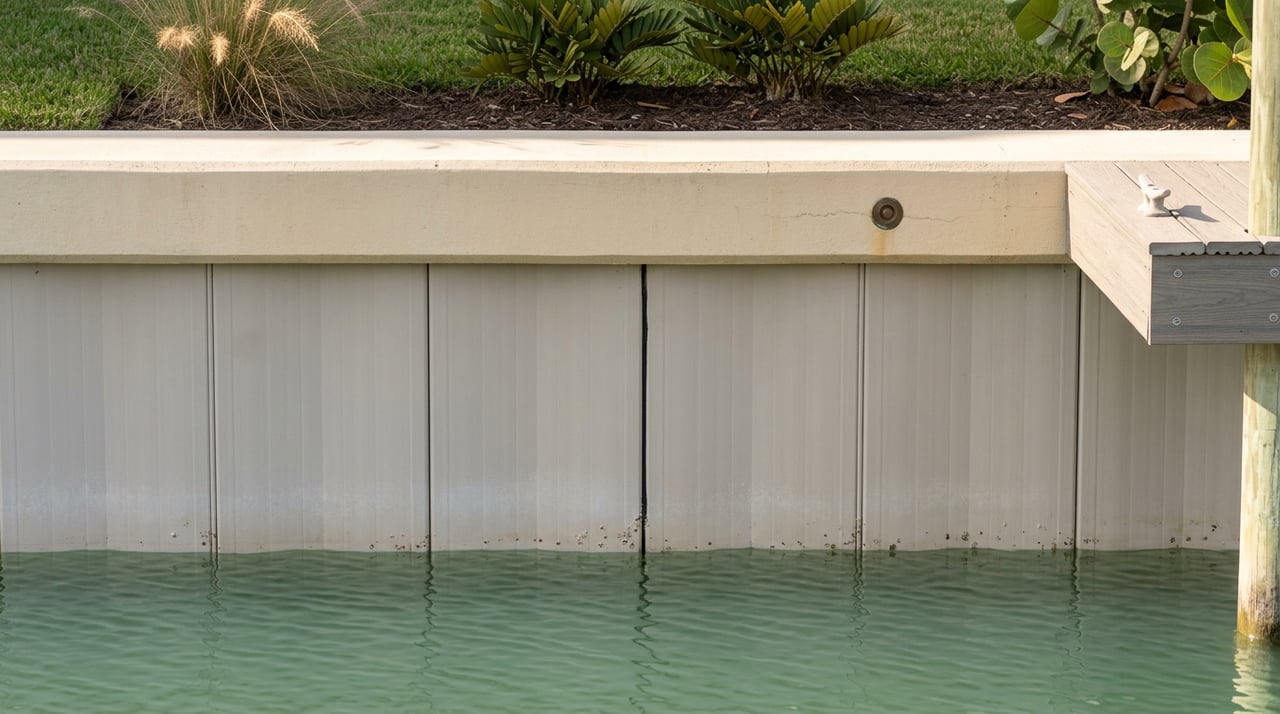
Buyers still tour the dock first. They step out onto the composite deck, look down at the lift capacity plate, count feet of frontage, and picture the boat. Sellers price the view. Both parties treat the wall holding the yard back from the canal as a given, the way you treat a driveway.
In the twelve months since Hurricanes Helene and Milton, that has stopped being true. The seawall is now the line item that most often moves a canal-front price in Apollo Beach between contract and close, and where a home sits inside the neighborhood decides whether that cost belongs to the buyer, the seller, or the community.
A dock can be rebuilt in weeks. A failed seawall is a six-figure capital project with permits, engineering, and a marine contractor waitlist attached.
Helene pushed 4 to 6 feet of surge into the canal-front neighborhoods, inundating hundreds of homes, and Milton followed thirteen days later with Category 3 winds. The canals that make Apollo Beach a boating market also became the delivery mechanism for bay water into living rooms. Sophisticated buyers noticed. So did their attorneys and their carriers.
The result is a market that still trades at coastal premiums but underwrites them differently. Waterfront homes that were once seen as premium lifestyle properties now carry a visible risk premium that buyers are factoring into every offer. That premium almost always attaches to the wall.
This is the piece most buyers do not price correctly, because the answer is neighborhood-specific and rarely appears in a listing description.
In most of Apollo Beach — the classic finger-canal streets platted decades ago, the no-HOA/no-CDD pockets that dominate listing copy, and gated enclaves like Andalucia and Symphony Isles — the seawall belongs to the homeowner. Full stop. The owner permits it, replaces it, insures around it, and negotiates it at closing.
MiraBay is the exception that trips people up. On the resale side of that community, MiraBay amenities include two heated pools, a poolside cafe, lounge with TVs, 24-hour gym, tennis, pickleball, basketball, three parks, miles of trails through Wolfe Creek Nature Preserve, a private boat launch, and two kayak and paddleboard launches, and the CDD covers seawall maintenance. A buyer comparing a MiraBay canal home to a similarly priced Apollo Beach original-platted home is not comparing the same asset. One transfers the seawall liability with the deed. The other socializes it through the CDD.
A few practical reference points on where responsibility typically lands:
Confirming this before an offer is drafted, not during due diligence, changes the negotiation.
A general home inspector will note the seawall's presence and material and stop there. That is not a seawall inspection. A useful review, run by a Florida-licensed marine contractor or a marine engineer, checks the components that actually fail:
A professional marine engineer or licensed contractor inspection runs $300 to $800 depending on wall length and accessibility, and many firms offer annual inspection programs for waterfront property owners. This is the best money a seawall owner can spend, because catching a $2,000 crack before it becomes a $60,000 panel failure is straightforward math.
Foundation Masters, a civil engineering firm working the Apollo Beach market, has publicly flagged specific streets seeing repeated seawall and retaining-wall failure calls, including Tybee Island Drive, Pinckney Drive, Sea Trout Place, Islebay Drive, Mirabay Boulevard, Merritt Island Drive, and Balibay Road. That list is not a verdict on any individual property. It is a map of where a buyer's inspection budget earns the most.
Repair and replacement pricing has moved. Costs have risen meaningfully since 2021 due to labor tightening, material inflation, and increased permitting complexity. The ranges below reflect what marine contractors are quoting across the Tampa Bay and Sarasota–Manatee corridor as of early 2026, cross-referenced against a Southwest Florida installer's published 2025 pricing.
| Scope | Typical cost range | Notes |
|---|---|---|
| Routine inspection | $300 to $800 | Annual programs available |
| Crack injection or minor concrete repair | $150 to $300 per linear foot | Polyurethane foam or epoxy |
| Batter or helical pile reinforcement | $2,500 to $6,000 per pile | 4 to 10 piles typical |
| Panel replacement | $500 to $750 per linear foot | Section by section |
| Full seawall cap replacement | $600 to $900 per linear foot | Cap only, panels retained |
| Full replacement, vinyl with concrete cap | $700 to $1,200 per linear foot | 50-year vinyl lifespan |
| Full replacement, concrete or steel | $500 to $1,200 per linear foot | 30 to 50 year lifespan |
| Permits and engineering | $500 to $2,000 | On top of construction |
On a standard 80-foot Apollo Beach canal lot, that math turns into a project between roughly $56,000 and $96,000 for a full vinyl replacement, and into six figures for a longer waterfront or a concrete build. A recent Apollo Beach listing quantified this directly, noting no interior flooding from recent hurricanes, only exterior seawall damage, fully replaced in 2025 with a brand-new $55K seawall carrying a 50-year warranty. That number is the offer-shifting figure a buyer should either see already spent or price into their bid.
What starts as a $3,000 crack injection repair can become a $150,000 full panel replacement if left unaddressed for two or three years. That escalation is the reason a marine inspection ordered at inspection period is worth more than any general home report on the file.
Florida sellers already disclose material facts affecting value. After 2024, seawall history is squarely inside that duty. Buyers in Apollo Beach are asking for the wall's age, material, warranty documentation, permit records, and any repair invoices, and reasonable sellers are producing them. Attorneys reviewing contracts on the buyer side are writing seawall-specific inspection contingencies where they used to write general ones.
The insurance side is where the transaction friction actually lives. Standard homeowner's insurance policies in Florida typically exclude seawall damage from wear, deterioration, or gradual deterioration. Some policies may cover sudden, accidental damage such as impact from a vessel. Hurricane-related seawall damage may be covered under a windstorm policy depending on the specific cause of loss. That ambiguity became a real problem in 2024. Was the roof leak from wind or surge? Was the interior water from rain coming through wind-damaged openings or from surge through the seawall? These disputes delay payouts and leave homeowners in limbo.
Buyers also underestimate the deductible math. Helene and Milton are two distinct hurricanes, which means two separate claims with two separate hurricane deductibles. For a homeowner with a $400,000 policy and a 2% hurricane deductible, that is $8,000 out of pocket per storm, $16,000 total, before insurance pays anything. A prudent underwriting model for a canal-front purchase should assume dual-deductible seasons happen, and that adjuster backlogs mean some Apollo Beach homeowners waited 3 to 6 weeks just for an initial inspection after Helene, only to need a second inspection after Milton.
The listings that are moving fastest in the current canal-front market are the ones that treat the seawall as a marketing asset rather than a fine-print item. That means:
Buyers who see a documented, warrantied wall will underwrite the property at closer to list. Buyers who see nothing will assume the worst and negotiate down to it.
Does a MiraBay CDD assessment guarantee the seawall behind my lot is sound? The CDD funds maintenance, but funding and current condition are different questions. Ask for the district's most recent seawall inspection schedule and reserve study before you write.
Is a vinyl wall worse than a concrete one on a resale? Not in the current market. Installing vinyl seawall panels costs $200 to $550 per linear foot on average, vinyl seawalls last 50 to 60 years and need little maintenance, and installers typically use concrete on the top for structural and aesthetic reasons. Buyers increasingly prefer vinyl-with-concrete-cap for its lifespan and corrosion resistance.
If a seller replaced the seawall in 2025, is that a real value-add or just a repair? It is a value-add in the current pricing environment. A recent full replacement removes the largest single unknown cost from a buyer's underwriting and typically closes a gap of $50,000 to $120,000 in perceived risk on a standard Apollo Beach lot.
Should I still buy a canal home in Apollo Beach? That is a personal call. What is not personal is that the seawall belongs in the offer analysis with the same weight as the roof, the HVAC, and the flood elevation. Treat it that way and the market is still workable. Treat it as an afterthought and the storms' lessons will be relearned at your expense.
The canal-front market in Apollo Beach has not lost its appeal. It has become a market where preparation, documentation, and a marine contractor on speed dial separate a smooth close from a repriced one. If you are considering a purchase or listing on the water in Apollo Beach, MiraBay, Andalucia, or the surrounding canal streets, Angie Richison will pair a data-informed pricing analysis with the local inspection and marine-contractor network you will actually need. Request a free market analysis to start the conversation.
Stay up to date on the latest real estate trends.

Experience a data-driven, relationship-focused approach to real estate designed around your success.
ANGIE RICHISON
ADDRESS 415 SANDSEND CT APOLLO BEACH FL 33572